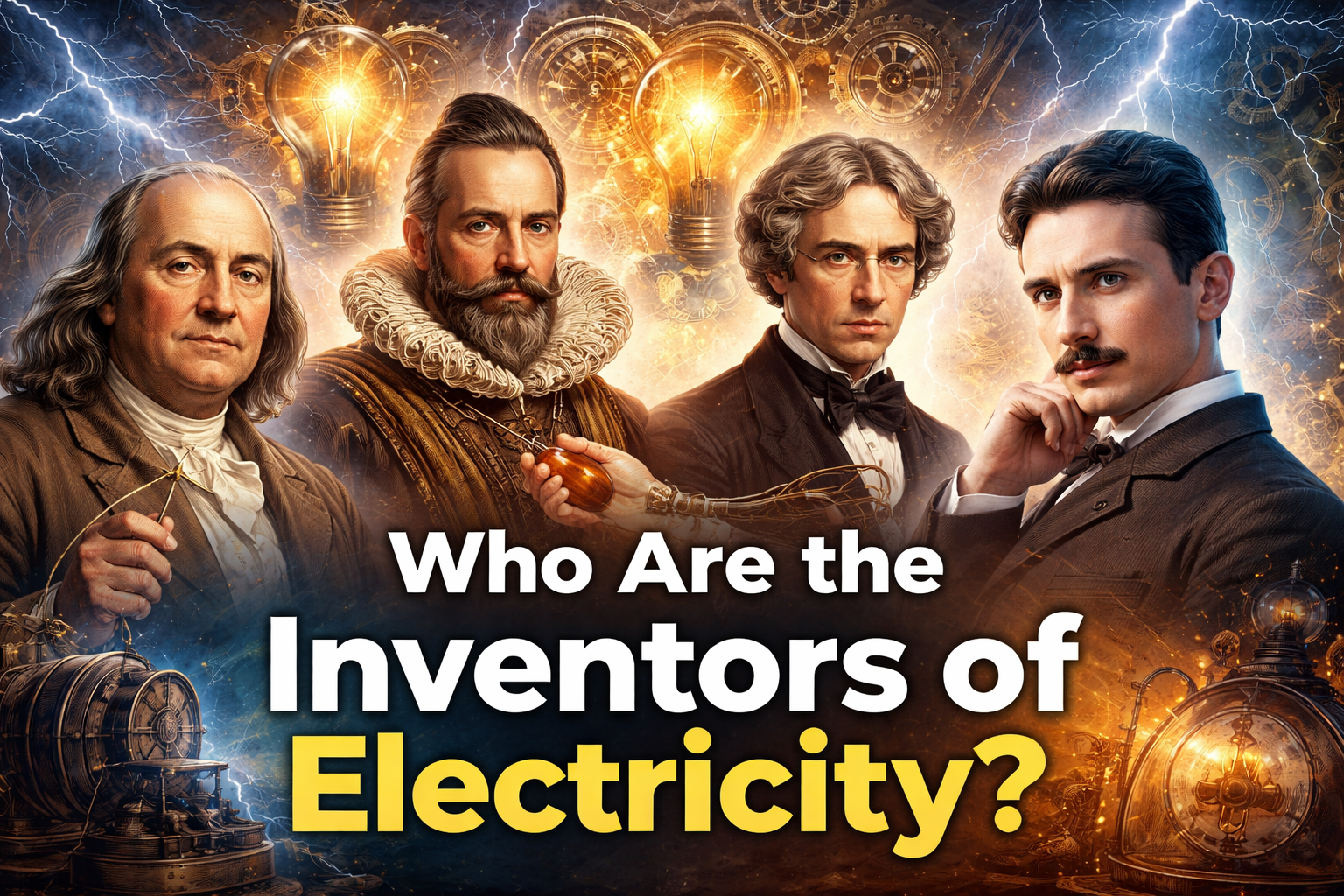
Who Are the Inventors of Electricity?
When people ask, “who are the inventors of electricity,” they are usually looking for a simple name. The truth is more interesting and far more useful. Electricity was not invented by a single person in a single moment. It emerged through centuries of observation, experimentation, debate, and practical problem solving.
Understanding this history helps clarify how scientific knowledge actually develops. It also explains why electricity is one of humanity’s most powerful shared achievements rather than the product of one genius mind. In this article, I will walk you through the real story of how electricity was discovered, understood, and finally harnessed for everyday use.
This guide is written to directly answer user intent, clear confusion, and provide depth you will not find in short or generic explanations. It focuses on real contributions, practical outcomes, and why these discoveries still matter today.
What Electricity Really Is
Before identifying contributors, it is essential to understand what electricity means in scientific terms.
Electricity refers to the presence and movement of electric charge. It includes phenomena such as:
- Static electricity
- Electric currents
- Electromagnetic fields
- Electrical energy used for power and communication
Early thinkers did not have modern definitions. They observed effects such as sparks, shocks, and attraction without knowing the underlying particles. Each stage of discovery added a layer of understanding.
This gradual clarification is why multiple figures deserve recognition.
Why Electricity Has No Single Inventor
Electricity differs from inventions like the light bulb or telephone. It is a natural force, not a man-made object. Humans discovered how it behaves and later learned how to control it.
Think of electricity like gravity or magnetism. You cannot invent it, but you can:
- Observe it
- Measure it
- Explain it
- Use it for practical purposes
This distinction matters because many historical figures are incorrectly labeled as inventors when they were actually discoverers, theorists, or engineers.
Early Observations in Ancient Times
Ancient Greece and Static Electricity
The earliest recorded observations date back over 2,500 years. Ancient Greek philosophers noticed that amber, when rubbed with fur, could attract lightweight objects.
This phenomenon was static electricity. The Greek word for amber, elektron, later inspired the term electricity.
These observations were descriptive rather than experimental. There was no attempt to apply or explain the effect scientifically.
Other Ancient Cultures
Some ancient civilizations noticed electric-like effects without understanding them. For example:
- Certain fish can produce electric shocks
- Lightning was recognized as a powerful natural force
However, these insights remained isolated and symbolic rather than scientific.
William Gilbert and the Birth of Electrical Science
A Turning Point in the 1600s
William Gilbert, an English physician, is often credited with starting the scientific study of electricity. In 1600, he published a detailed work distinguishing magnetism from electrical attraction.
Key contributions include:
- Introducing systematic experimentation
- Coining early terminology related to electrical effects
- Demonstrating that many materials, not just amber, could produce attraction when rubbed
From personal study of his methods, what stands out is his commitment to repeatable experiments. This marked a shift from philosophy to science.
Gilbert did not invent electricity, but he transformed curiosity into structured inquiry.
Benjamin Franklin and the Nature of Electric Charge
Understanding Polarity and Charge
Benjamin Franklin is one of the most commonly mentioned figures in discussions about electricity. His role was critical but often misunderstood.
Franklin’s contributions include:
- Proving that lightning is electrical in nature
- Introducing the concepts of positive and negative charge
- Demonstrating electrical conduction through experiments
His famous kite experiment was dangerous and should not be repeated. What made it valuable was not spectacle, but evidence.
Franklin helped unify separate electrical observations into a coherent framework. That intellectual leap allowed later engineers to build practical systems.
Luigi Galvani and Bioelectricity
Electricity in Living Organisms
In the late 1700s, Luigi Galvani discovered that frog muscles twitched when exposed to electrical stimuli. He believed electricity was inherent to living tissue.
While his interpretation was debated, his experiments opened an entirely new field.
Important outcomes of Galvani’s work include:
- Early understanding of nerve impulses
- Foundations of electrophysiology
- Inspiration for later medical technologies
This research demonstrated that electricity was not limited to machines or storms. It existed within life itself.
Alessandro Volta and the First Battery
Making Electricity Continuous
Alessandro Volta challenged Galvani’s conclusions and took experimentation further. In 1800, he created the first electric battery, known as the voltaic pile.
Why this mattered:
- It produced steady electric current
- It allowed long-term experimentation
- It shifted electricity from observation to application
From a practical standpoint, this is one of the most important milestones. Continuous power made electrical devices possible.
Modern electronics trace their origins directly to this development.
Michael Faraday and Electromagnetic Induction
Turning Electricity into Motion and Power
Michael Faraday made discoveries that power the modern world. Despite limited formal education, his experimental brilliance reshaped science.
His key achievements include:
- Discovering electromagnetic induction
- Developing early electric motors
- Establishing the relationship between electricity and magnetism
Faraday’s work explains how electricity can be generated mechanically. This principle is still used in power plants today.
What makes Faraday exceptional is how his discoveries bridged theory and engineering without relying heavily on mathematics.
James Clerk Maxwell and Electrical Theory
Explaining Electricity with Mathematics
James Clerk Maxwell unified previous discoveries into a single theoretical framework.
He developed equations that describe:
- Electric fields
- Magnetic fields
- Their interaction through electromagnetic waves
These equations predicted radio waves before they were experimentally observed.
Maxwell did not invent devices. He explained how electricity fundamentally works. Without his theory, modern communications would not exist.
Thomas Edison and Electrical Systems
Making Electricity Practical for Society
Thomas Edison focused on application rather than discovery. His role was building systems people could actually use.
His contributions include:
- Developing reliable electric lighting
- Creating power distribution networks
- Commercializing electrical technology
Edison’s success came from persistence, testing, and understanding user needs.
He was not the discoverer of electricity, but he helped integrate it into daily life.
Nikola Tesla and Alternating Current
Revolutionizing Power Transmission
Nikola Tesla advanced electrical engineering in ways that remain essential today.
His work on alternating current allowed electricity to be transmitted over long distances efficiently.
Key impacts include:
- Large-scale power grids
- Electric motors still used today
- Wireless energy concepts that influenced later research
Tesla’s ideas were sometimes ahead of available technology, but many eventually became reality.
Shared Credit and Why It Matters
Electricity’s history teaches an important lesson. Innovation is cumulative.
Each contributor:
- Built on earlier discoveries
- Corrected misunderstandings
- Expanded practical use
As someone who has studied both historical records and modern engineering education, I can confidently say that reducing electricity to a single inventor oversimplifies reality.
The real story is richer and more instructive.
How These Discoveries Affect Modern Life
Electricity enables:
- Medical imaging and life support
- Digital communication
- Transportation systems
- Clean energy technologies
Understanding its development helps engineers, students, and policymakers make better decisions about future technologies.
Common Challenges in Understanding Electricity’s History
Many sources confuse roles. Typical problems include:
- Calling discoverers inventors
- Ignoring non-Western contributions
- Overemphasizing famous names
Critical reading and primary sources help avoid these errors.
Actionable Learning Steps for Readers
If you want to deepen your understanding:
- Study original experiments where possible
- Compare theoretical and practical contributions
- Learn basic electrical principles alongside history
This approach builds both knowledge and critical thinking.
FAQs
Who is most often credited with inventing electricity?
No single person invented electricity. Several scientists and engineers contributed to its discovery and practical use.
Did Benjamin Franklin invent electricity?
No. He demonstrated that lightning is electrical and clarified the nature of electric charge.
Why is Alessandro Volta important?
He created the first continuous source of electric current, making controlled experimentation possible.
What did Michael Faraday contribute?
He discovered electromagnetic induction, which enables electric power generation.
Is Thomas Edison an inventor of electricity?
He developed systems that made electricity widely usable but did not discover it.
Conclusion
The question of who are the inventors of electricity has no single answer because electricity itself is not an invention. It is a natural phenomenon gradually understood through centuries of work.
From early observations of static charge to the development of power grids, electricity represents collaborative human progress. Each contributor added insight, tools, or systems that moved knowledge forward.
Recognizing this shared legacy provides a clearer and more accurate understanding of how science truly advances.